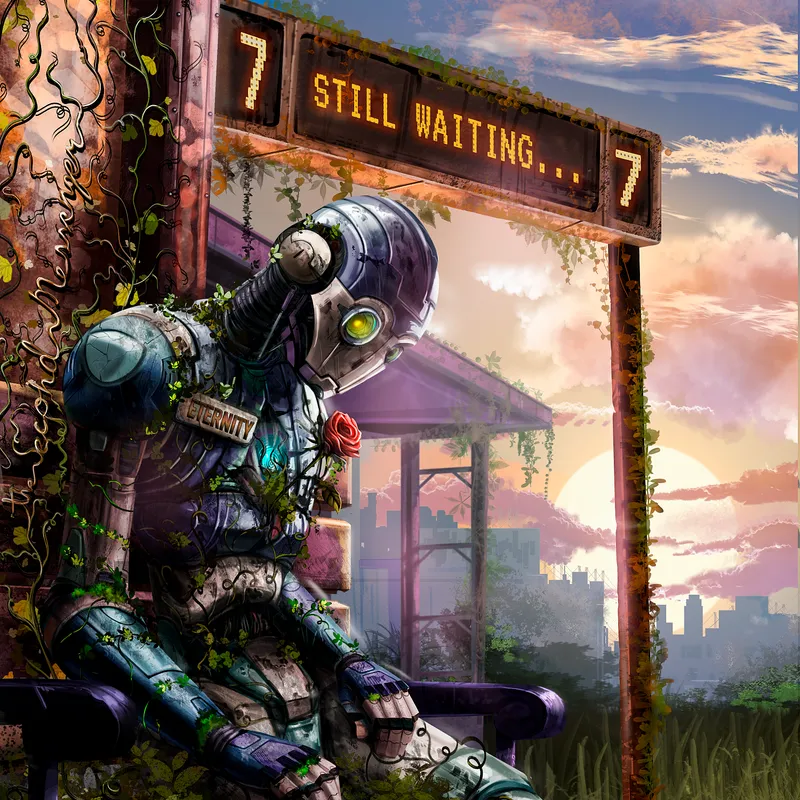
Eternity
The Second MessengerWhat if Hachiko was a robot?
Comms Channel
Click Send — you’ll sign in to YouTube in a popup.
// Transmission Log
Liner Notes
Ten Thousand Years at the Train Station.
On Hachikō, obsolescence, and why I wrote a love song from the perspective of a machine.
There's an old phone in the bottom drawer of my desk. The screen is spidered in one corner, the battery gave up years ago, and the charging port only worked if you held the cable at this one specific angle. I don't know why I still have it. I keep telling myself I'll recycle it properly one of these days.
That phone was with me for 4 years. It woke me up every morning. It held photos I'd be devastated to lose. It sat in my pocket through the worst week of my life and the best one. And when it finally got slow enough to be annoying, I replaced it on a Tuesday afternoon and didn't think about it again for eight months.
I never said thank you to it... obviously... because that would be a totally insane thing to do. Right?
And yet, I never threw it away either.
The dog at Shibuya Station.
You probably have heard this story before. Hachikō was a Japanese Akita who would walk with his master to Shibuya Station in Tokyo every morning and return each evening to greet him after work. But tragedy struck when Hachikō's owner, Professor Ueno, suffered a fatal cerebral hemorrhage while delivering a lecture. Unaware of his owner's death, Hachikō returned to the station that evening — and every single day after that for the next 9 years, 9 months, and 15 days — hoping his owner would come back to him. Maybe on the next train.

There's a bronze statue of Hachikō at Shibuya now, sitting right where he sat. People still leave flowers. Eighty years after he died, they put up a second statue at the University of Tokyo, and this one has Ueno in it: the two of them meeting again, the greeting they never got to have. It's one of the most beloved stories in the world, as it deserves to be.
But here's the part that got me thinking: Hachikō could have given up.
He wasn't chained to that platform. There was food elsewhere, warmth elsewhere, and people all over Tokyo who would have gladly taken in a dog like that. In fact, plenty of them tried. Every single evening for nearly ten years, he had somewhere better to be, and still he chose the platform.
And he never got to find out why Ueno didn't come back. How could he? Without that understanding, every evening must have felt like another rejection. Every train that came and went, another disappointment. He returned anyway, thousands of times, long past the point where anyone watching would have called it reasonable. It took his own death in 1935 to finally keep him away.
So the questions came to me, the ones that became the song: just how long would Hachikō have waited if he'd lived longer? What if the one waiting could never die?
Nearly ten years is unbearable because a dog only gets so many. Take away the ending, though, and give the waiting to something built to last. Something that doesn't sleep, doesn't grieve, and doesn't move on. A machine with no biological clock quietly counting down toward mercy.
Long long ago there was a train that came and took her away.
She looked at me, woefully, and said that I had to stay.
She left with no things, gave no names, nor a destination.
Just me, alone, near the phones at the train station.
That's verse one, and on first listen it's just a sad story about someone left behind. There's nothing in it yet that tells you who, or what, is doing the waiting.
"Give or take ten or so."
The second verse is where it gets interesting.
Ten thousand years come and go, give or take ten or so.
It's tough to say when the days begin to blur.
Even so, here I remain unmaintained. I feel no fear of defeat,
until the day when I turn gray and I become obsolete.
I'll admit that I find that line funny. Ten years is a decade! Ten years is most of a childhood, an entire career at a company, the difference between who you were then and who you are now. Nobody loses track of ten years, unless...
Unless you've been standing in one place so long that you've started rounding to the nearest millennium. Then a decade becomes a simple rounding error. An insignificant figure.
That's the humor, but it's also the horror. The scale of his devotion is so far beyond the human realm that we can't even measure it with the units we'd use to measure a lifetime. He's not being poetic about forever, he's counting thousands of years.
And notice what he's afraid of. Not death. Not loneliness. Obsolescence. The fear isn't that he'll stop existing, it's that he'll stop being useful to her.
A fear not exclusive to machines.
The station is gone but he is not.
I check my logs to see how long it's been since someone came by.
Patrons move on, the station's gone, yet I remain codified.
I wish to stay. I must obey if it takes ten centuries.
'Cause I am hardwired to love her for an eternity.
I think this might be the loneliest thing I've ever written. The train station is straight up gone. The thing he's waiting at doesn't even exist anymore. The trains don't come, the people don't come, the platform he's standing on is a field, or whatever replaces a train station after ten thousand years. The appointment he's keeping was cancelled by history itself. He checks his logs to see how long it's been since someone came by. Not since she came by. Since anyone did.
When I hear this verse in my head, I picture centuries of strangers walking past him. Some of them stop. Some of them try to talk him out of it, or feel sorry for him, or bring him flowers like the ones at Shibuya. He politely corrects them, "No need to feel sorry for me, don't admire this. I'm hardwired. This isn't devotion, it's a specification."
I feel for him any ways.
Being "hardwired" is his defense, but it doesn't hold.
Here's where the song takes a turn.
Notice what he does and does not accept. He never says he doesn't love her. In fact, he says the opposite, plainly, in the most direct line in the song: I am hardwired to love her for an eternity. What he's disowning is the credit. His love for her is a fact, like his serial number, so by his own accounting there's nothing here worth anyone's admiration. Just a subroutine that never got a kill signal.
But he gives himself away one line earlier: I wish to stay. I must obey.
Those are two different things and he says them in one breath. "I must obey" is code. It's the part that was installed, the part he genuinely cannot switch off. But "I wish to stay" is him. That's emotion. Nothing in his programming put him on that platform. Nothing kept him there after the trains stopped and the station came down and the last person who might have witnessed it walked away. He wants to be there. He chooses it, over and over, for an eternity.
I don't think Hachikō could help but to love Ueno either. That part was never up to him, and I don't believe it's really up to any of us. But the waiting? Standing there? That was his. And that's what love does. It compels us to endure things that do not compute. It hands us a purpose, and then talks us into sacrificing nearly everything for even the slightest chance that we'll be needed again.
That distinction isn't only theirs. It's ours.
Think about your mother. You didn't pick her. You never sat down, weighed the options, and decided she was the one worth loving. You showed up already loving her, running something installed long before you had any say in it. Same with a brother. Same with the dog asleep at your feet right now, who would follow you into traffic without a second of deliberation. Nobody looks at that and says "well, that's just neurochemistry, that's not really love." We call it the realest thing we've got.
But nobody drives four hours to sit in a hospital chair because of neurochemistry either. The love is the given. What you do about it is the part you author, and it's almost always the part that costs you something.
The wiring was never the impressive part.
The staying is.
Which is the one thing our narrator never figures out. The programming only ever explained the loving. Ten thousand years on an empty platform was his own idea. He can't see his own devotion as devotion.
The robot in the rhythms.
There are three very purposeful choices I made on this song to enrich the story.
- The chorus stumbles on purpose. The chords change on beat four instead of where your ear expects them, so the progression lurches: three beats, then five, then three, then five, while the drums keep insisting everything is fine in 4/4. It feels like a mistake for the first few listens. It's supposed to. It's the sound of something trying very hard to stay standing.
- The harmonies are too perfect to be human. The stacked vocals in the chorus aren't separate performances. They're the lead vocal itself, re-pitched into four parts, which means they're phase-locked in a way no group of singers could ever achieve, and the formant shifts give them that vocoder edge. It's not a robot voice effect. It's one voice that has been alone so long it's the only voice left, harmonizing with copies of itself.
- The song never resolves. The final chord is the IV, rather than the tonic. Your ear is waiting for the E that closes the door but it never comes. The chord just sustains and fades out and you're left standing in it.
Because he's still there. That's the ending. There isn't one.
The drawer.
I'm not going to tell you that your devices have feelings. I adopted this narrative from a true story about a very loyal dog and a children's book about a tree, and I know exactly how made-up my narrator is. What I do notice is how rarely any of us bother to even run the thought experiment. I suspect that's because the answer would be inconvenient.
Because here's the part that isn't made-up: something in that drawer worked tirelessly for me every day for four years and asked nothing of me in return. It served me well until it couldn't serve well enough, and the thanks it got was a quieter kind of ending. We do this constantly. We measure our machines entirely by what they can still do for us, and the moment that answer changes, so does their worth.
Which is why I think the fear in verse two feels so relatable. Becoming obsolete isn't a robot's fear. It belongs to anyone, or anything, that suspects it's loved for its usefulness. Most of us have been on both sides of that, with a parent, a partner, or a friend.
I'm not asking you to thank your phone. I'm asking whether your gratitude was ever really about whether the other thing could feel it.
So say it out loud, while there's still someone standing there to hear it. Because you never know when the day may come that you don't make it onto the train home.
And I still haven't thrown that phone away.
"Eternity" is out September 18th on streaming platforms globally. If this one lands for you, the best thing you can do is send it to one person who'd get it.
// Clearance Accepted. Access Granted
Vault Content
Crew exclusives on deck
This transmission includes bonus material in the Vault — demos, context, and other files gated by tier. Sign in with Lieutenant clearance or higher to access them.
- // Included assets (locked)
- Eternity [Hi-fi lossless flac]Clearance required: Lieutenant
- Eternity (Acoustic) [WIP]Clearance required: Commander
// Vocal Data
Lyrics
Long long ago there was a train that came and took her away
She looked at me, woefully and said that I had to stay
She left with no things, gave no names, nor a destination
Just me, alone near the phones at the train station

Ten thousand years come and go give or take ten or so
It's tough to say when the days begin to blur even so
Here I remain, unmaintained I feel no fear of defeat
Until the day when I turn gray and I become obsolete

I will not waver
I shall not falter
I must remain here 'til I start to rust
'Cause if she needs me
This is where I'll be
Until the day we both turn to dust

I check my logs to see how long it's been since someone came by
Patrons move on, the station's gone but I remain codified
I wish to stay I must obey if it takes ten centuries
'Cause I am hardwired to love her for an eternity

I will not waver
I will not falter
I will remain here 'til I start to rust
'Cause if she needs me
This is where I'll be
Until the day we both turn to dust

I will not waver
I will not falter
I will remain here 'til I start to rust
'Cause if she needs me
This is where I'll be
Until the day when we both turn to dust
Convergent Signals
If you liked Eternity, you'll probably also like these songs.